Thanks to financial support from individuals, families, businesses and fundraisers, in 2023 Permaculture Australia’s Permafund funded community projects by nine organisations around the world.
The Kitgum Permaculture Practitioners’ Association in Uganda, East Africa, received a grant of AU$2,000 to offer its deaf community a permaculture design course {PDC} and syntropic agroforestry training. The objectives of the project were to equip participants with basic permaculture and syntrophic agroforestry knowledge and best practices.
Assembly of garden tools
The mix of trainees included youth, the deaf, single mothers, school dropouts, school heads and employees. The grant supported the trainers with course presentation materials, seeds and seedlings, hoes, pangas (machetes), forked hoes, spades and a wheelbarrow.
The course included an introduction to permaculture, the ethics and principles, soil science, seeds and seedlings, land preparation, mulching, planting and composting plus pest, weed and disease management.
Preparing the garden beds
The introduction to syntropic agroforestry included soil cover, stratification for maximum photosynthesis, succession and site management.
Mulching the raised beds
At the end of the training each of the 36 participants (11 female and 25 male) received two fruit or windbreak tree seedlings to kick start their syntrophic regenerative dream.
Planting seeds & seedlings
After the course the facilitator reported that 95% of the students were equipped to replicate and adopt syntropic agroforestry best practices in their community to help improve environmental conservation. They learnt the benefits of planting native and endangered tree species to restore diversity.
The vegetable, medicinal plants and tree seedlings used in the training included: spinach, Skuma wiki (collard greens), tomatoes, eggplant, field peas. Crotalaria, okra, green pepper, malakwang (roselle plant), cucumber, kale, cabbage and dodo (amaranth). Fruits included passionfruit, banana, oranges, mango, jackfruit, paw paw, cashew nut, guava and coffee. Wood & shade trees included teak, neem, pines, eucalyptus and a native hardwood. Grasses used were lemongrass and elephant grass.
Seedlings in recycled containers
Challenges for the teachers were
unavailability of a training manual and student notes
Limited funds
poor internet access and lack of data bundles for effective communication.
inadequate species of native trees
insufficient catering and accommodation facilities
unrealistic expectations from students re start-up funds for their project, training allowances and transport refunds.
Some people were vegetarian, and others could not eat the food prepared due to allergies causing extra work for support staff.
Catering by support staff
Recommendations from the organisers for the way forward
Access to training for trainers to roll out syntropic agroforestry education into the community
Incorporate permaculture and syntropic agroforestry for diversification
Extension of programs to schools and institutions where the most active age bracket and fast learners are found f or easy management and learning
Development of effective work plans and budget
Set up more community learning demonstrations to rouse interest and encourage replication
Develop an administrative unit with smart phone and laptop for easy reporting
Develop training manuals for references during and after trainings
In conclusion the training was well attended and well facilitated with both the teachers and students showing zeal and passion for the training. The time management for the course was viewed as good, including time taken to gather the training materials. The food was sufficient for breakfast, lunch and tea breaks.
The facilitator, Patrick Paul Kidega thanked Permaculture Australia’s Permafund for the opportunities provided by the funding. He also thanked the Abundant Earth Foundation for their support over the years.
He requested help in the future with train the trainer education for the most outstanding students to equip them to start practicing and sharing permaculture and syntropic agroforestry knowledge with the community of Kitgum and Uganda at large.
Donations and tithes from individuals and businesses to Permaculture Australia’s Permafund are warmly welcomed with amounts over $2.00 tax deductible in Australia.
Compost making workshop
Funds raised by community events such as Open Garden Days, social gatherings, workshops and festivals provide wonderful support for Permafund’s grant program.
Contributions to the Permafund can be made here via PayPal or direct deposit. Thanks to everyone for your support.
In their successful application to the 2023 Permafund grant round, Anam Cara House in the Australian town of Colac, Victoria, described its main purpose as “To provide the South West Victorian community with excellence in respite and end of life care within a home-like environment; embracing respect and compassion for all people.”
They explained “We operate a day hospice program, 4 days a week. There are many participants who have a life-long love of the outdoors and gardening so we often do outdoor garden activities with them.
Day respite at the hospice provides a vital break for carers and gives the participants opportunities to enjoy different activities and socialise.”
Anam Cara House described their project as “Permaculture gardening – a community and social experience for people with a chronic life limiting illness. Our aim is to develop an existing site on the hospice grounds with raised wicking garden beds for food production. The food grown will supply our kitchen for homemade meals for our guests.”
The Permafund management team has been receiving regular progress reports from the Community Liaison Nurse, Naomi Lettieri.
“Our permaculture garden project is going along well. We have planned out the space and identified the size of the raised garden beds and the required space around the beds so someone in a wheelchair can move around the space. Initially we had planned to use a different site, but after meeting and considering our best options, we are positioning the garden beds in a location closer to the hospice building.
Our respite guests and maintenance team have been consulted on the plans. We have identified what items we already have that can be recycled or repurposed for the activity to start. We have ordered our garden beds to be made by a local tradesperson, using recycled, untreated cypress timber with a food grade wicking lining.
Everyone is excited about this project and we are talking to local businesses about how they can support us with some of the components as donations, such as gravel for fill, sand and soil.
“The excavation will be done as a working bee with volunteer support. We have the site preparation well underway, the garden beds with the lining are on site. We are hopeful to be ready for spring planting.” Our Thursday day respite participants have been involved in the decision making and planning. Our maintenance team and volunteers have been assisting with the groundwork. We are excited to see the project develop to get the garden beds in place and growing food for the hospice kitchen. “
Once the new garden beds were set up Naomi reported “We are delighted to let you know that we planted out the wonderful wicking garden beds with some of our day respite participants 2 weeks ago.
The participants really enjoyed the experience, and the plants are already growing well.
It will be a great activity as time goes by as the gardens become well established.” Anam Cara House, Colac, Victoria will continue to share reports about the impact of this project.
Thanks to the build up of donations from individuals, businesses and groups throughout each year the Permafund management committee is able to regularly launch a grant round.
Applications to Permafund for funding for environmental and permaculture education projects are received from a wide variety of community organisations both in Australia and regions around the world -from the Pacific to Asia, Africa to the Americas.
Donations and tithes from individuals and businesses to Permaculture Australia’s Permafund are warmly welcomed with amounts over $2.00 tax deductible in Australia.
Funds raised by community events such as Open Garden days, social gatherings, workshops and festivals provide wonderful support for Permafund’s grant program.
Contributions to the Permafund can be made here via PayPal or direct deposit. Thanks to everyone for your support.
The Democratic Republic of Congo remains one of the richest in terms of natural resources yet is still one of the poorest countries in the world. Its colonial history was savage. There was a failure to hand over any semblance of administrative and executive governance during the country’s pathway to Independence in 1960. The result is a tragic trail of dictators who, through corruption, have prospered while their people have struggled.
It’s in this environment that Permafund’s grant program has entered its 17th country by partnering with an NGO known as the Union of Women for Rural and Community Development which goes under the acronym UFEDERCO.
They’ve been operating in the region of South Kivu in the east of the DR Congo since 2015. They have a broad range of areas where they assist the most vulnerable women and children with food security and sustainable agriculture, legal and judicial assistance for victims of gender based sexual violence, the promotion of the environment, education and access to water.
The AU 2000 Grant Permafund provided went directly into starting food gardens in 2 primary schools. The project aims to fight against malnutrition in schools, improve the economic and social livelihoods of women in poor families and increase food and organic seed production to make the region more resilient toward food sovereignty.
Most of the budget was for the purchase of the initial seeds and equipment for making the garden beds. The materials were distributed to 700 students from the 2 schools as well as to 60 women farmers selected on need who then formed Permaculture committees to oversee the project. The main crops grown include cabbage, potatoes, eggplant, amaranth, onions, peppers, carrots, and dongodongo.
700 school children benefitrd from the permaculture training supported by Permafund
Also part of the project was a series of educational training related to Permaculture topics such as developing soil fertility and making organic pesticides. Over 70 marginal farmers were involved in this training.
Utilising garden tools was part of the students’ training
This was an early report from the project which seems to be going well. The main outcomes will occur at harvest time, and then how well they can save the seeds so that the school gardens continue to go on year after year.
This is the type of project where Permaculture can make a big difference…..where the need is great. $2000 is allowing 700 children and over 100 women farmers to have a chance at a better quality of life by improving their nutrition. We’ll keep in contact with this group in the Congo and look forward to both further reports and maybe assisting them again in the future.
Fundraisers such as open gardens and community events to support Permafund’s micro-grant program are a wonderful help and are very much appreciated.
All gifts, tithes and donations made by individuals and businesses to the Permafund that are over $2 are tax deductible in Australia and are warmly welcomed.
Contributions to the Permafund can be made here. Many thanks.
Discussions were deep, laughter aplenty, the fire burnt hot, warming so many
For the first time since the lock down period, permies from around the country were able to gather again, this time on Peramangk country in South Australia.
With the inspiration to recognise the movement’s roots and early beginnings a plan was hatched to create an informal community space at the Australian Permaculture Convergence 2023 in South Australia modeled on the original Chai tent at Woodford Folk festival in 1984, co-created by Robin Clayfield, Skye, Karin and Hans Erkin.
The aim was to create a comfortable space to lounge and debrief from each day’s activities. The chai tent was well received by the Mount Barker community on the Friday night Twilight market event, attended by over 600 people.
The following days during the APC saw lots of crushing of spices, turmeric and ginger. The scent of chai drifted through the beautiful site of the Waldorf School, drawing in people to enjoy a nice cuppa and have a chat.
A small team of volunteers from the East Coast, supported by a local crew, set out to raise funds for Permaculture Australia’s Permafund that supports permaculture projects around the world.
The crew created the space and cooked up lots of hot and spicy cups of chai served with local honey and lovely dark chocolate covered Medjool dates filled with macadamia butter. A special handmade pottery mug was created and crafted by a local potter in Berry NSW to raise funds for Permafund.
The feedback the organisers received from the attendees was overwhelmingly positive, and that it was a testament to the incredible energy and enthusiasm that the chai crew brought to the event.
The Cosmic Chai Tent project was able to donate $2200 to Permafund.
Crew member John Champagne of Brogo Permaculture said, “We’ve started a conversation about privilege in and around permaculture circles lately and communities coming together to raise funds for Permafund offer us all an opportunity to assist those in greatest need and manifest our Third Ethic of Fair Share.”
Fundraisers such as open gardens and community events to support Permafund’s micro grant program are a wonderful help and are very much appreciated.
All gifts, tithes and donations made by individuals and businesses to the Permafund that are over $2 are tax deductible in Australia and are warmly welcomed.
Contributions to the Permafund can be made here. Many thanks.
The Rafiki Community-Based Organisation in Nairobi Kenya successfully applied for a $2,000 Permafund grant in early 2023 to support their Rafiki Urban Farming program.
PROGRESS REPORT:
Their community initiative is being implemented in Viwandani informal settlements in the city to promote sustainable and resilient food production systems by applying permaculture ethics and principles.
The program was initiated to address food insecurity, improve nutrition, poverty and environmental degradation in the community. By implementing permaculture practices, the program seeks to empower the local community to grow their food, reduce their dependence on external food sources and improve their overall well-being.
Since its inception, the Rafiki Urban Farming program has made significant progress in various aspects. Firstly, the program has successfully mobilised and engaged the community in the establishment and maintenance of urban farms. Through awareness campaigns and capacity-building workshops, community members have been trained on permaculture and organic farming techniques and sustainable resource management.
As a result of these efforts, a considerable number of urban farms have been established across Viwandani informal settlements. These farms have not only provided a source of nutritious food but have also served as spaces for community cohesion and skill-sharing.
Vertical gardening with recycled contaners
The program has facilitated the formation of farmers’ groups where members collaborate, exchange knowledge, and support each other in implementing permaculture practices. Moreover, the program has successfully reached its initial target of establishing 50 individual and communal permaculture gardens within the community. These gardens are owned by residents to ensure widespread access to fresh produce. As a result, more than 50 individuals now have direct access to nutritious food from their gardens, reducing their reliance on expensive market purchases.
The current status of the Rafiki Urban Farming program is highly encouraging, achieving several notable accomplishments. Firstly, the program has significantly increased access to fresh and nutritious produce for the community members, with a diverse range of crops and herbs being cultivated. This has positively impacted food security and improved the overall health and well-being of the residents, particularly vulnerable groups such as children and the elderly.
Permaculture training leading to food production solutions
Plus the program has empowered community members by providing valuable knowledge and skills in permaculture and sustainable farming practices. This has led to increased self-reliance, as farmers can now grow their food, make their compost and reduce reliance on external sources. Additionally, the program has created income-generating opportunities through surplus produce sales, contributing to poverty alleviation and economic empowerment within the community.
Furthermore, the program has raised awareness about the importance of sustainable agriculture and environmental conservation. Through community events, workshops, and educational materials, the program has disseminated information on permaculture ethics and principles, leading to a broader understanding and appreciation for sustainable practices. The program has also forged partnerships with local schools, enabling the integration of permaculture into the curriculum and fostering a culture of sustainability among the younger generation.
Challenges encountered
● Lack of access to quality organic inputs, such as compost and organic fertilisers. Participants are encouraged to compost their organic waste and share it with others, creating a decentralized composting network.
Utilising available resources with practical results
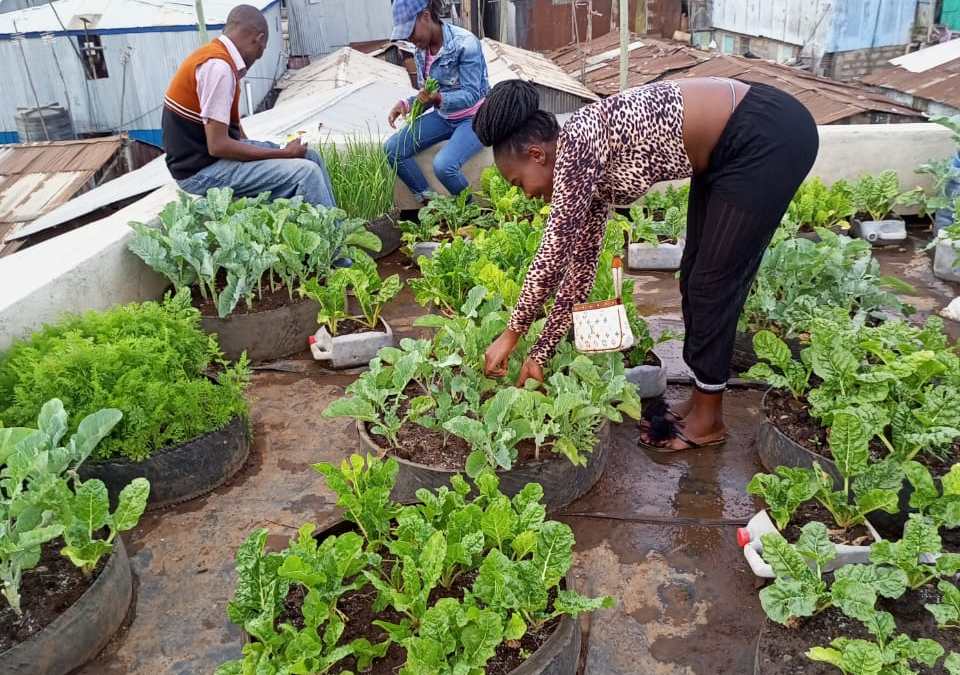
● Limited space so innovative solutions adopted such as vertical gardening, rooftop farming and re-purposing small, unused spaces.
Saving space recycled containers & hanging gardens
● The knowledge and skills gap has been addressed by conducting regular training sessions covering permaculture principles, organic farming techniques, soil management, pest control, and crop rotation
● Climate change and water scarcity: Limited amount of water available for irrigation. Viwandani, like many other urban areas, is vulnerable to the impacts of climate change, including erratic rainfall patterns and water scarcity. These climatic conditions pose challenges for urban farming, particularly in maintaining adequate water supply for irrigation. To address this, the program focused on water conservation and management strategies such as rainwater harvesting and water recycling (kitchen water and bathing water). By implementing these measures, the program has reduced water wastage and ensured efficient water use in urban farms.
● Community Engagement and Ownership: Initially, there was resistance and scepticism among some community members regarding the effectiveness and long-term sustainability of the program. To overcome this challenge, the program emphasised community engagement and participation. Regular community meetings, dialogue sessions, and participatory decision-making processes were conducted to involve the community in program planning and implementation. By fostering a sense of ownership and active participation, the program gained community support and commitment, leading to the success and sustainability of the urban farms.
Report recommendations
Scaling Up and Replication: Given the success and impact of the program in Viwandani, it is recommended to consider scaling up the initiative to other sub-villages of Viwandani informal settlements within the region. This could be achieved through collaboration and continuity of partnership and supporting other local organisations with similar objectives and goals to replicate the program’s model and share best practices. By expanding the program’s reach, more communities can benefit from permaculture education and information, sustainable urban farming practices, improving food security and promoting resilience.
Using all available space to produce a harvest
Strengthening Partnerships: Continual collaboration with local organisations, government agencies and donors is essential to ensure the availability of necessary resources and support. Strengthening existing partnerships and establishing new ones will enhance the program’s capacity to overcome challenges related to resource constraints, access to inputs, and funding. This could be achieved through regular coordination meetings, joint fundraising efforts and knowledge-sharing platforms.
Training and Capacity Building: Continuous training and capacity-building programs for farmers and community members should be prioritised. These programs should focus on advanced permaculture techniques, composting, organic pest management, and soil conservation. Providing access to training resources, workshops, and mentoring will ensure that farmers have the necessary skills and knowledge to maintain productive and sustainable urban farms.
Restoring fertility in under utilised spaces
Education and Awareness: Continued efforts to raise awareness about the importance of sustainable agriculture and environmental conservation should be carried out. This could involve conducting educational campaigns in schools, organizing community events, and disseminating information through various media channels. By educating the broader community about the benefits and practices of permaculture, the program can encourage more individuals to adopt sustainable farming methods and contribute to a healthier and greener environment.
Monitoring and Evaluation: Implementing a robust monitoring and evaluation system is crucial for tracking the program’s progress, identifying areas for improvement, and measuring its impact. Regular assessments of the urban farms’ productivity, environmental sustainability, and community well-being will provide valuable feedback to inform program adjustments and ensure its long-term success.
The way forward
The way forward for the Rafiki Urban Farming program in Viwandani Informal Settlement involves a strategic approach to sustain and expand the program’s impact.
Consolidate and Strengthen Existing Farms: It is crucial to ensure the continued success and productivity of established urban farms. This involves providing ongoing support to farmers, including access to resources, technical guidance and mentorship. Regular monitoring and evaluation should be conducted to identify areas for improvement and provide targeted assistance where needed. By consolidating the existing farms, the program can maintain its sustainability and maximise its impact.
Expand the Program’s Reach: Building on the success achieved in Viwandani, the program should aim to expand its reach to other informal settlements within the region. This can be done by conducting community needs assessments and identifying potential partner organizations or community leaders who can champion the program in new locations. Engaging with local stakeholders and tailoring the program to meet the specific needs and challenges of each community will be crucial for successful replication and expansion.
Foster Knowledge Exchange and Networking: Creating platforms for knowledge exchange and networking among farmers, experts, and stakeholders is essential for continuous learning and innovation. This can be achieved through regular community meetings, workshops, and farmer-to-farmer exchanges. Encouraging the formation of networks or associations among urban farmers will facilitate the sharing of best practices, challenges, and solutions, fostering a supportive and collaborative environment.
Urban farming between buildings and on rooftops
Enhance Value Addition and Market Access: Exploring opportunities for value addition and market access can contribute to the economic sustainability of the program and the farmers involved. This can involve training farmers in post-harvest handling techniques, food processing, and marketing strategies. Collaborating with local markets, restaurants, or food cooperatives to establish direct links between farmers and consumers will ensure fair and sustainable trade relationships.
Secure Long-term Funding: Securing adequate and sustainable funding is crucial to sustain the program’s activities and ensure its long-term impact. The program should explore diverse funding sources, including government grants, corporate social responsibility initiatives, philanthropic organisations, and crowdfunding platforms. Developing a comprehensive fundraising strategy and cultivating partnerships with donors and investors who share the program’s vision will provide the financial stability needed to continue and expand the program
All contributions to the Permafund are warmly welcomed to support permaculture environmental and education projects in Australia and around the world. Gifts, regular tithes and donations to the Permafund over $2.00 are tax deductible in Australia and can be made here. Many thanks.




You must be logged in to post a comment.